


Many difficult conversations are avoided not because people don’t care, but because they care deeply and don’t want to upset someone, create discomfort, or “rock the boat.” Whether it’s providing feedback, setting boundaries, addressing concerns, or speaking up about something awkward, many of us hesitate. Yet avoiding difficult conversations can sometimes have a greater impact than the conversation itself. A simple experience involving a dryer sheet hanging from my pant leg reminded me of the important difference between being nice and being kind.
Kindness and Being Nice: What’s the Difference?
I did some quick research and found that being nice can feel like:
- Avoiding conflict or discomfort in order to seek approval.
- A surface-level response, such as smiling or being polite.
- The desire not to “rock the boat.”
- Intentionally not upsetting others.
- Telling people what they want to hear.
Kindness, on the other hand, is more about action:
- Taking action to assist, even when it feels uncomfortable.
- Doing what is right for the right reasons and with the right intention.
- Acting from a place of empathy and genuine care for yourself and others.
- Prioritizing what is helpful over what is merely comfortable.
- Being honest with others, even when the conversation feels difficult.
The Dryer Sheet Lesson
I recently rewatched a conversation between Simon Sinek and Trevor Noah about kindness and being nice. Their discussion reminded me of an experience that taught me a valuable lesson about kindness, feedback, and difficult conversations.
Years ago, I attended a public event with a dryer sheet hanging from the inside of my pant leg.
If I had noticed it myself, I probably would have burst into laughter and turned it into a story for future presentations. Instead, the experience became a lesson about the difference between being nice and being kind.
As I moved around the room, talking with people, no one mentioned the dryer sheet.
Later, when I was discussing the incident with someone, she said, “Oh, I’m so glad someone finally mentioned it. I saw it earlier, but I didn’t want to embarrass you.”
At first glance, it sounds thoughtful. She didn’t want to hurt my feelings.
Yet, when we talked further, we discovered something important. Her hesitation wasn’t really about protecting me from embarrassment. It was about avoiding her own discomfort in bringing it up.
I shared that I would have felt far less embarrassed if someone had quietly told me about the dryer sheet than walking around the room unaware while everyone else noticed it.
The person who eventually spoke up did so quickly and kindly. She simply said, “Just wanted to let you know there’s a dryer sheet hanging from the inside of your pants.”
I replied, “Oh my gosh, thank you so much for telling me.”
That was it.
No drama. No awkwardness. No embarrassment.
Just kindness in action.
And of course, I laughed at myself and continued to get a chuckle of this… How many other times had this happened?
Difficult Conversations Can Be Acts of Kindness
Many people avoid difficult conversations because they don’t want to make things worse. They worry about emotions, conflict, reactions, or saying the wrong thing.
Yet some of the most important conversations are the ones we avoid.
We sidestep them. We soften them. We hint around them. Or we say nothing at all.
The result?
Opportunities for growth, understanding, connection, and problem-solving are missed.

We can share feedback in a kind, clear way. As Brené Brown famously says:
“Clear is kind.”
We can set boundaries from a place of care, empathy, and respect.
We can offer feedback with compassion.
We can address concerns before they become bigger issues.
In many cases, difficult conversations are actually acts of kindness because they help someone learn, grow, or become aware of something they cannot see themselves.
Why We Avoid Difficult Conversations

Giving someone feedback, addressing conflict, or having a difficult conversation often creates discomfort. We may worry about rocking the boat, making the situation worse, damaging a relationship, or triggering strong emotions.
As a result, some of the most important conversations are avoided, delayed, or approached indirectly.
When we communicate from a place of emotional regulation, empathy, and genuine care, however, difficult conversations become opportunities to build trust, strengthen relationships, and create greater understanding.
The goal is not to win the conversation. The goal is to create connection while addressing what matters.
Kindness Is an Action
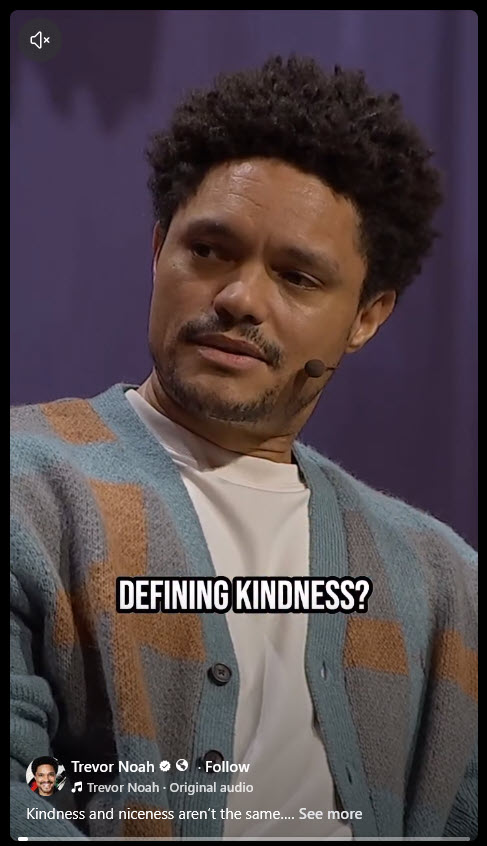
In the Simon Sinek and Trevor Noah conversation, Trevor talks about having something on your face and no one telling you.
His point is simple.
If you notice something that could help another person, kindness means respectfully letting them know.
Kindness is not always comfortable.
Kindness sometimes requires courage.
Kindness often means stepping into a moment of discomfort for the benefit of someone else.
And that brings us back to the dryer sheet.
The person who said something demonstrated kindness through action. She cared enough to speak up.
She chose a moment of discomfort so that I could avoid a much larger one.
That’s often the nature of difficult conversations. What feels uncomfortable in the moment can be incredibly helpful in the long run.
A Reflection for the Week Ahead
As you move through your week, consider:
- Where are there opportunities to choose kindness over simply being nice?
- Is there a difficult conversation you’ve been avoiding?
- How might clear, respectful communication help someone?
- How can you acknowledge the impact of someone else’s kindness on you?
Sometimes the smallest moments offer the biggest lessons.
Even a dryer sheet can teach us something about difficult conversations.
Want Help Having a Conversation You’re Avoiding?